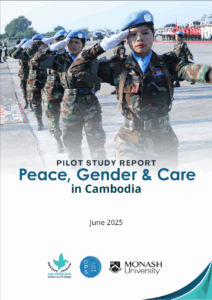
Monash GPS and WPM Cambodia have just launched a Report (Khmer and English) presenting findings of their research on the intersection of gender, peace and care in Cambodia. Research was conducted in 2024-25 with key stakeholders in Cambodia, including the Ministry of Women’s Affairs (MoWA); National Peacekeeping Force, Mines and Explosive Remnants of War Clearance; and representatives of civil society organisations and international organisations, including the UN. The aims of the research were to:
Reflect on the impact of caring responsibilities on the meaningful participation of women in peace and security work, namely peacebuilding and peacekeeping.
Discuss the interconnections between gender, care and peacebuilding, and discuss the utility of employing a care lens in peacebuilding and peacekeeping policy and practice.
Provide input to key stakeholders discussing the development of the Women, Peace and Security (WPS) National Action Plan (NAP) regarding the intersection of gender, care and peacebuilding, particularly the impact of unpaid care work on the participation of women and the effectiveness of security and peace programming, policy and practice.
Research findings underscore the critical importance that women can and do have in security and peace work, not least because of their unique experiences and needs as well as the diversity of skills, knowledges and capacity they possess. It also highlights the significant barriers to women’s engagement that arise through care work. This is because of:
- The gendered nature of unpaid care work – women undertake most care work (90% in Cambodia), meaning women have less time, less capacity and often less resources
- Gender normative assumptions about unpaid care work and peace and security work as sometimes being incompatible
- Maternal bias (assumptions about the capabilities and commitment of mothers) and discrimination against women with caring responsibilities, which curtails engagement, recruitment, retention, training and promotion prospects
- Lack of support and practical obstacles (e.g. limited access to affordable childcare, lack of flexibility at work)
The Report proposes aligning efforts to advance the WPS agenda and work to support carer-givers. It argues that this can help address barriers to women’s participation and advance efforts to progress peace, security and development. Recommendations to better support carer-givers in peace and security work include:
- Recognise and value unpaid care work as critical to societal well-being, resilience and development
- Raise awareness of care work as a shared responsibility, and requiring a whole-of-society approach
- Advance an ethics of care in peace and security work, connecting care for others, duty of care and self-
care - Invest in gender responsive policies and budgeting, and gender-responsive social protection mechanisms
- Ensure access to affordable childcare and support mechanisms (formal and informal) for carers
- Expand gender training and address maternal bias in organisations engaged in peace and security work
- Recognise and support the critical role of women in formal and grassroots peace and security work
Cambodia’s commitment to WPS is evidenced in the adoption of a Regional Plan of Action on Women, Peace, and Security by the Association of Southeast Asian Nations (ASEAN) in 2022, under Cambodia’s Chairmanship (ASEAN 2022). It’s commitment to care and supporting those with caring responsibilities is further demonstrated in two recent awards received by MoWA, namely, the 2024 ASEAN Care Economy Recognition Award and the 2024 Asia Pacific Care Champion. These commitments are further underpinned by Cambodia’s dedication to the Sustainable Development Goals (SDGs). The Report will be launched in Phnom Penh, Cambodia on 27 June 2025.
“Without care, we will not be able to promote or ensure peace, either inner or outside ourselves or to family members or to the community or society as a whole.”
“We want to have a better world for our next generation, and that needs all of us, and not just one half of the skies… we want to foster a better way for women today and also in the future. And not just women, but all of us, every one of us.”
Read and download for free here:
Peace, Gender & Care in Cambodia-English
Peace, Gender & Care in Cambodia-Khmer
Peace, Gender & Care Brief-English
Peace, Gender & Care Brief-Khmer